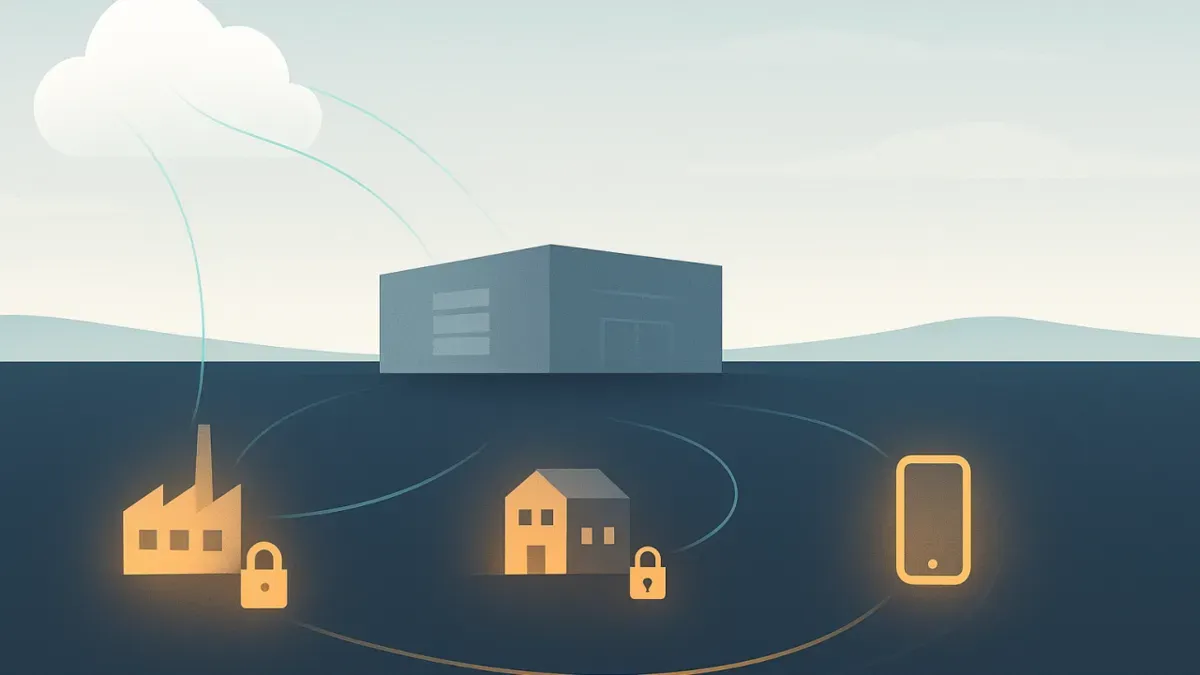
Cloud AI keeps tightening the rules. That’s not random; it’s the price of scale.
Since the cloud craze, the industry has pushed businesses into centralized control planes. For many workloads that improves governance and reliability. AI is different. The most valuable AI work needs privacy, predictability, and memory close to where the work happens.
Hardware has quietly caught up. Local AI is now good enough for real work. That’s the signal: some of the highest‑value AI doesn’t fit cleanly in the center.
Treat edge and your private data center as one system. The cloud coordinates. Your DC curates. The edge executes. That keeps control near the work—and still benefits from the cloud.
Edge AI isn’t a side experiment. It is standard architecture.
Five business reasons it now makes sense
1) Privacy and sovereignty move from feature to requirement
Businesses expose their most sensitive thinking to AI: source code, strategy, customer data, operational decisions. Centralized platforms demand trust boundaries many organizations can’t accept or legally cross.
Edge + private DC change the trust model:
- Data stays inside known boundaries at the edge
- Policies and audit live in private DC
- No third‑party retention risk or platform policy drift
This isn’t paranoia. It’s protecting intellectual capital.
2) Real ownership of behavior and resilience
When AI lives entirely on someone else’s platform, you don’t own its behavior. A unified edge/private DC restores control across:
- Model selection and update cadence in private DC; local enforcement at edge
- Prompting strategies and failure modes tuned to workflows
- Cost envelopes and capacity planning aligned to data gravity
That control becomes operational resilience: tune to your workflows, adapt when platforms change, avoid sudden regressions.
3) Durable context turns AI from chatbot into teammate
The most valuable systems are stateful. They remember conversations, track goals, and learn how work happens. Centralized platforms struggle: persistent memory is expensive, long‑running sessions add risk, personalization strains shared infrastructure.
Edge makes long‑running sessions natural within a unified system:
- Maintain durable context locally; share relevant summaries to private DC
- Run continuous agents tied to local environment and policies
- Build real working relationships with users and teams while preserving sovereignty
4) Organizational learning compounds locally
The next phase of value is institutional intelligence: shared embeddings, codified best practices, cross‑project insights, and true institutional memory.
Centralized platforms are a tough place to host that safely and economically. Edge + private DC let you:
- Learn collectively without leaking knowledge
- Accumulate proprietary intelligence over time in private DC
- Edge feeds outcomes; private DC accumulates shared memory
That’s the difference between AI as a subscription and AI as a strategic asset.
5) The stack has landed—and TCO follows
This isn’t theoretical. Vendors now ship real edge AI across CPUs, GPUs, NPUs, and enterprise endpoints. Private DC tooling covers orchestration and governance.
Compute sits near the work; curation sits in the DC. That’s how you get latency, cost predictability, and offline resilience, with the DC curating models, policies, and shared memory.
What the cloud actually clarified
Cloud platforms reveal the boundary of centralized AI. Safety, governance, and predictability matter—but they don’t satisfy every business need. Edge isn’t a rebellion. It complements the cloud.
It’s not cloud or edge. It’s cloud coordinating edge—policies, updates, and fleet telemetry in the cloud; privacy, control, memory, and learning where the work and data live.
That future isn’t pending. It is here.
Broader industry signals: access gating, default guardrails, and provider‑controlled lifecycles are converging. This trend is locking businesses into control planes they didn’t select—and that may not match their objectives.
Edge and Private DC: One System, Two Roles
Treat edge and private data center as one distributed system with a unified control plane.
Roles
- Private DC: source of truth for models, policies, and org memory; orchestrates fleets.
- Edge: execution layer close to data and users; enforces policies locally.
Flow
- Publish from private DC; subscribe at edge. Cache models, embeddings, and policies.
- Telemetry and outcomes flow back to private DC for evaluation and retraining.
Fit
- Edge: low‑latency, privacy‑critical inference; continuous agents tied to local context.
- Private DC: fine‑tuning, shared embeddings, cross‑team memory, high‑throughput batch.
Control and compliance
- Edge keeps data resident; private DC provides auditability and lifecycle governance.
Resilience and cost
- Edge reduces backhaul and survives WAN loss; private DC amortizes heavy compute and simplifies lifecycle.
Winning pattern: cloud coordinates; private DC curates; edge executes. Align control with data gravity—keep privacy, durable context, and learning near the work, with cloud as coordination, not custody.
Conclusion
- Elevate privacy and control to first‑order concerns
- Treat durable context and shared learning as inevitable
- Position edge AI as infrastructure, not a developer preference
Sources
- Azure OpenAI overview and model access controls: https://learn.microsoft.com/en-us/azure/ai-services/openai/overview
- AWS Bedrock Guardrails: https://aws.amazon.com/bedrock/guardrails/
- Google Vertex AI safety settings: https://cloud.google.com/vertex-ai/generative-ai/docs/safety
- Microsoft Edge for Business: advanced data protection for BYOD and AI (2025-03-24): https://blogs.windows.com/msedgedev/2025/03/24/new-advanced-data-protection-for-byod-and-ai-in-edge-for-business/
- Microsoft Edge for Business: Secure Enterprise AI Browser: https://www.microsoft.com/en-us/edge/business/ai-browsing
Supporting Arguments
- LinkedIn’s edge architecture for diverse inference workflows and long‑running sessions (InfoQ, 2025): https://www.infoq.com/news/2025/09/linkedin-edge-recommendations/
- RCR Wireless on test‑time inference scaling and edge opportunity (Qualcomm view): https://www.rcrwireless.com/20250210/ai-infrastructure/convergence-of-test-time-inference-scaling-and-edge-ai
- Rajat Gupta on Edge AI, local inference, privacy/compliance (LinkedIn, 2025): https://www.linkedin.com/posts/kkanhiya_edgeai-aiarchitecture-iot-activity-7410376311954870272-ElF6
- Coverage of Microsoft’s enhanced protection for AI/BYOD users (Cybersecurity News, 2025-03-25): https://cybersecuritynews.com/microsoft-announces-new-enhanced-protection/