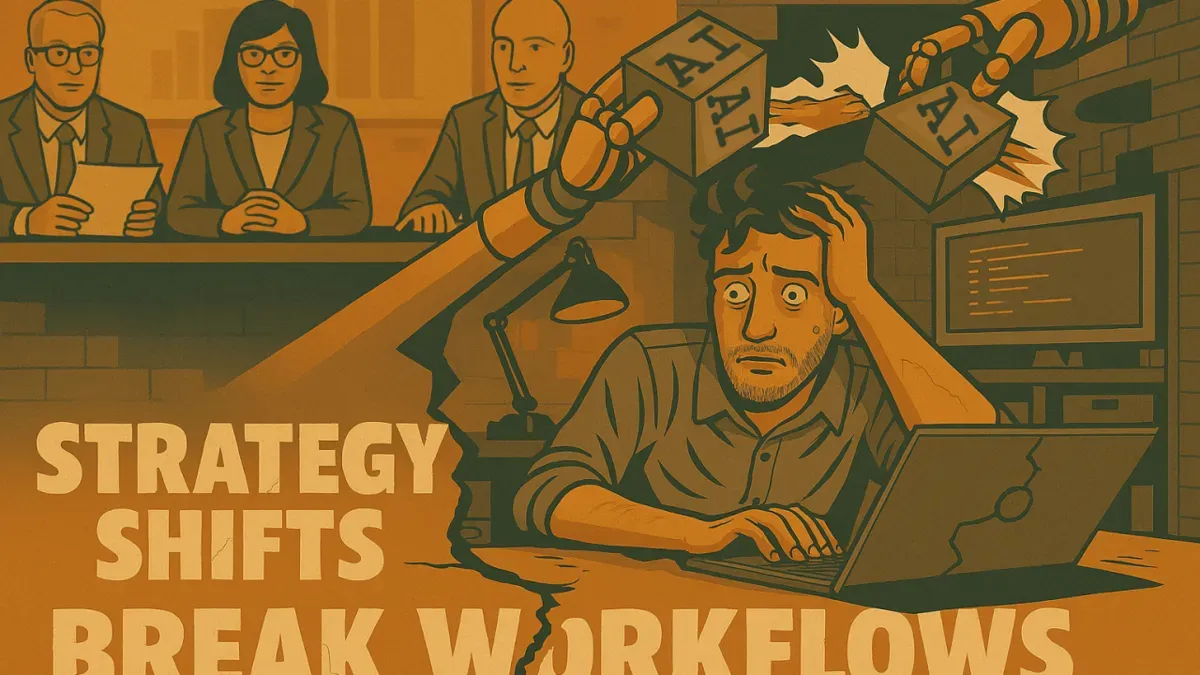
Anthropic’s recent decision to restrict access to Claude through independent tools and open channels has generated a lot of discussion, but the deeper story emerges when looking at the structural effects. Analyzing the move through the lenses of platform dynamics, cloud incentives, and board-level governance, a clear realignment comes into focus — one that reshapes the competitive landscape in ways that matter far beyond a single model provider.
This is the reasoning path that led me there.
1. The implications point to a shift toward enterprise-centric control
Anthropic’s new restrictions narrow the pathways through which their models can be used. The immediate effects are straightforward:
- fewer integration surfaces
- more curated entry points
- tighter control over usage
- reduced exposure to unpredictable environments
- a distribution model that favors enterprise channels
These are not small adjustments. They represent a meaningful shift in how Anthropic wants its models to be consumed.
To fully understand Anthropic’s realignment, we need to explore how the strategic postures of major cloud players intersect with governance dynamics that ultimately shape distribution decisions.
2. Strategic spectrum and board-level governance: The forces shaping Anthropic’s realignment
The reason to focus on Amazon and Microsoft is not size — it’s strategic posture. The strategic contrast between Amazon and Microsoft is less about scale and more about ecosystem philosophy — openness versus centralization — which sets the stage for understanding Anthropic’s move.
Amazon’s advantage
AWS thrives when ecosystems are open, modular, and diverse. Their model flourishes as customers assemble their own stacks, mix tools freely, and innovate at the edges. Breadth drives AWS adoption.
Microsoft’s advantage
Microsoft excels when ecosystems consolidate around centralized entry points — identity, productivity, collaboration, operating systems, and AI assistants. When distribution narrows, Microsoft’s existing surface area amplifies its influence.
Anthropic’s move shifts the ecosystem toward centralization, naturally strengthening Microsoft and weakening Amazon.
Board-level context: governance tied to Microsoft, AWS, and Nvidia
Crucially, Anthropic’s board composition — with deep ties to Microsoft, AWS, and Nvidia — exerts a powerful influence on the company’s risk tolerance and distribution strategy. Anthropic’s board and investor structure includes deep ties to:
- Microsoft
- AWS-aligned funds
- Nvidia
These aren’t passive investors. They are strategic stakeholders whose incentives shape Anthropic’s risk posture, distribution strategy, and enterprise alignment.
Boards don’t dictate product details, but they absolutely influence:
- liability tolerance
- regulatory posture
- enterprise credibility
- cloud-partner alignment
- revenue predictability
- acceptable risk surfaces
When a company with this board composition tightens distribution, it’s not surprising. It reflects the gravitational pull of its strategic investors.
Anthropic’s decision is consistent with a governance structure that prioritizes enterprise trust, controlled deployment, and predictable usage over broad ecosystem reach. These governance dynamics translate into tangible distribution effects. When access tightens, the platform with the broadest integrated surface area gains disproportionate advantage.
3. The emerging pattern: centralization benefits the platform with the most surface area
Anthropic’s shift has a predictable downstream effect:
- When access is open, Amazon’s breadth is an advantage.
- When access is controlled, Microsoft’s surface area becomes the dominant force.
This shift is not about model superiority or pricing — it’s about control over the channels through which AI is accessed and integrated.
And in that environment, Microsoft’s position strengthens. Given these aligned incentives and governance pressures, it’s reasonable to conclude that Anthropic’s realignment is a deliberate strategic repositioning.
4. Was this an intentional strategic realignment?
Before diving into the question of intent, it’s important to recognize the alignment of incentives and pressures shaping Anthropic’s decision. Understanding this context sets the stage for assessing whether the realignment was deliberate.
My conclusion: yes, the realignment is intentional, even if every downstream effect wasn’t explicitly planned.
The decision aligns too cleanly with:
- enterprise-centric incentives
- board-level risk posture
- cloud-partner alignment
- a desire for predictable, governed usage
- a shift away from uncontrolled experimentation
This is not an accidental outcome. It’s a strategic repositioning. The unfolding consequences of this realignment will ripple across the AI ecosystem, reshaping influence, innovation, and developer experience.
5. The outcomes will be fascinating to watch
Regardless of intent, the consequences are significant:
- Amazon risks losing influence over the emerging hybrid and edge-driven AI workflows that will shape the next decade.
- Microsoft gains leverage as the ecosystem consolidates around the interfaces it already owns.
- Anthropic strengthens its enterprise posture but risks losing presence in the environments where new patterns are invented.
- Nvidia benefits either way: as open-model ecosystems accelerate and local compute becomes more important and controlled enterprise adoption increases.
- Hybrid AI architectures become increasingly central as organizations seek flexibility and control.
- Frontline developers grapple with the changes: this is where hybrid workflows, local acceleration, and agentic orchestration are being invented. When a provider restricts access to that frontier, they reduce their presence in the environments that shape the next generation of AI workflows.
That absence affects Amazon more than Microsoft, because AWS depends on being the substrate for whatever patterns emerge.
We’re watching a platform shift in real time — one where the center of gravity is quietly moving. In sum, this is a pivotal moment in the AI platform war — one defined not by models alone, but by who controls the gateways to AI adoption.
Conclusion
This isn’t just a policy update — it’s a seismic strategic realignment, shaped by board-level incentives and cloud-partner power plays. Distribution gravity shifts decisively toward Microsoft’s strengths, leaving Amazon on the sidelines and Anthropic repositioned as a tightly governed, enterprise-first player.
Front line developers bear the real cost, left to navigate the chaos as a beloved model is ripped from their workflows, casualties of a strategic cascade they never signed up for.
Whether driven by risk aversion, investor alignment, or a broader strategic calculus, the ripple effects will define the next phase of the AI platform war. It won’t be decided by model quality, but by who commands the channels through which AI is accessed, integrated, and adopted.
That battle has now entered a fierce new phase.
Sources
- Microsoft, NVIDIA, and Anthropic announce strategic partnerships — Official announcement detailing the strategic partnerships, investments, and compute commitments.
- Anthropic valued in range of $350 billion following investment deal with Microsoft, Nvidia — Coverage of the investment deal and valuation impact.
- Microsoft, Nvidia, and Anthropic’s $30B AI Alliance Reshapes Tech Landscape — Analysis of the strategic alliance and its market implications.
- Findings from a Pilot Anthropic—OpenAI Alignment Evaluation Exercise — Insights into Anthropic’s alignment research and evaluation methodology.
- Anthropic’s AI Access Restrictions and Their Implications for the Global AI Ecosystem — Analysis of Anthropic’s AI access policies and geopolitical alignment.
- Comparing Meta, Microsoft, Amazon and Google Artificial Intelligence Investment Strategies — Overview of AI investment strategies among major tech companies.
- Amazon AI Investment and Efficiency Drive Amidst Competition — Insights into Amazon’s AI investment and competitive positioning.
- The Partner Opportunity For Microsoft Dynamics 365 (Forrester) — Analysis of Microsoft’s AI business solutions and partner ecosystem.
- Microsoft AI Cloud Partner Program — Details on Microsoft’s AI cloud partner program and incentives.
- New York’s RAISE Act: What Frontier Model Developers Need to Know — Legal context relevant to AI model governance and developer impact.